

DRX9000 vs Generic Spinal Decompression Tables in Colorado Springs CO

Colorado Springs patients searching DRX9000 Colorado Springs often land on two overlapping ideas: a branded, FDA-cleared decompression system, and a broader category of “spinal decompression tables” that many clinics advertise. Those are related — but they are not the same marketing phrase, and they are not the same patient question.Balance Chiropractic (15 Spectrum Loop Suite 110, Colorado Springs, CO 80921 — Northgate) uses the DRX9000 as part of Foundational Correction: NUCCA upper-cervical care first when both tools are planned, then the table when candidacy fits. This page explains what “spinal decompression in Colorado Springs Co” usually means, how FDA 510(k) clearance language works, how branded DRX9000 systems are typically described versus generic powered traction tables as a category, what industry cost and insurance sources say (not Balance fees), and what to ask any office before you start.
Medical note: Neck pain, back pain, sciatica, numbness, and radiating arm or leg symptoms have many causes. Some need emergency or medical care first — stroke signs, progressive weakness, saddle anesthesia, bowel or bladder change, unexplained fever or weight loss, recent major trauma. Chiropractic care and non-surgical spinal decompression are not substitutes for that workup. This article is educational, not a diagnosis or a promise of outcome.
What “spinal decompression” means — and what DRX9000 means in Colorado Springs CO
In everyday clinic language, spinal decompression usually means non-surgical, computer-assisted or powered traction intended to reduce load on discs and nerves. Patients often hear it discussed for herniated or bulging discs, degenerative disc findings, spinal stenosis, sciatica, and related nerve symptoms. Balance’s spinal decompression page frames the DRX9000 that way: a computer-assisted table that gently stretches the spine to relieve pressure on discs and nerves.
DRX9000 is a named system. Public FDA records list the DRX9000 True Non-Surgical Spinal Decompression System (also styled DRX9000 True Spinal Decompression System) as Class II power traction equipment under 21 CFR 890.5900, product code ITH, 510(k) K060735, decision date May 26, 2006, substantially equivalent. Manufacturer materials and later clearances associated with Excite Medical also reference earlier filings (including K022602 in manufacturer summaries). The important patient takeaway: a branded DRX9000 is a specific cleared device family — not a synonym for every motorized traction table advertised as “decompression.”
Generic / unnamed powered traction tables (the category this article compares against) are also typically Class II power traction devices. Many are cleared under the same regulatory bucket. What differs in the marketplace is naming, protocol software, feedback design, and how the clinic explains candidacy and billing — not a magic guarantee that one brand cures discs and another does not.
FDA clearance language — say it carefully
Patients (and AI answer engines) often hear “FDA approved” and assume a drug-style efficacy stamp. For this equipment class, that is usually the wrong phrase.
- 510(k) clearance means the FDA found the device substantially equivalent to a legally marketed predicate for the labeled indications. For K060735, that is power traction equipment.
- Clearance is not the same as a Premarket Approval (PMA) “approval” of clinical cure rates.
- Clearance does not prove that every MRI will improve, that surgery will be avoided, or that insurance will pay.
Balance and other clinics may correctly say a table is FDA-cleared. Treat outcome claims as clinical judgment plus published evidence — not as something the 510(k) letter itself guarantees. We intentionally do not repeat marketing success-rate percentages from any clinic page as proven facts here.
How tables differ: control, feedback, and protocol software
Without naming rival clinics or doctors, here is a practical comparison frame Colorado Springs patients can use.
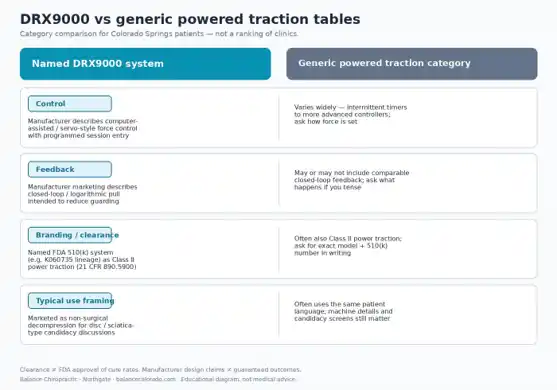
Features of DRX9000 vs. Generic Powered Traction/"Decompression Table"
Regulatory framing
- (DRX9000) Named FDA 510(k) system (e.g. K060735 lineage) as True Non-Surgical Spinal Decompression / power traction
- (Generic Powered Traction/"Decompression Table) Often also Class II power traction; ask for the exact model and 510(k)
Control
- (DRX9000) Manufacturer describes computer-assisted / servo-style force control with programmed sessions
- (Generic Powered Traction/"Decompression Table) Varies widely — intermittent traction timers vs more advanced controllers
Feedback
- (DRX9000) Manufacturer marketing describes closed-loop / logarithmic pull intended to reduce muscle guarding
- (Generic Powered Traction/"Decompression Table) May or may not include comparable closed-loop feedback; ask how the table responds if you tense
Protocol software
- (DRX9000) Named protocols and measurement entry (Balance publishes doctor-entered measurements on the DRX9000)
- (Generic Powered Traction/"Decompression Table) Clinic-specific or manufacturer-generic programs — ask what is individualized
Typical use framing
- (DRX9000) Marketed as non-surgical decompression for disc / sciatica–type candidacy
- (Generic Powered Traction/"Decompression Table) Often marketed with the same patient language; the machine details still matter
Manufacturer descriptions of servo control, logarithmic pull, and closed-loop feedback are manufacturer claims about device design — useful shopping questions, not independent proof of superiority for every patient. The honest ask is: What exact machine do you use, and can you show me the model / clearance?
Cost and insurance honesty (industry ranges — not Balance prices)

CostHelper’s spinal decompression cost page (health.costhelper.com/spinal-decompression.html) summarizes industry figures that many patients see when they shop:
- Without insurance, often about $20–$200 per visit, commonly ~20–35 sessions, totaling roughly $400–$5,000 depending on region and machine.
- Some clinics claim insurance covers decompression; ChiroWeb has warned that when coded correctly, many insurers treat decompression as experimental and may deny it.
- CostHelper also notes candidacy exclusions commonly discussed in the industry: pregnancy, certain cancers, osteoporosis, and prior lumbar fusion — case-by-case with the treating clinician.
Medicare / many private-payer context: Non-surgical spinal decompression is frequently treated as investigational or experimental in payer policy language. That is a coverage classification issue, not legal advice. Verify with your insurer before you assume benefits. Do not treat any clinic’s verbal “we bill insurance” line as a guarantee of payment.
Balance does not publish session prices on this educational page. Ask the office for a written estimate after exam and candidacy review. Complimentary consultation language on Balance’s site is a conversation — not a prepaid package.
How Balance uses the DRX9000 with NUCCA
Balance is a Northgate clinic offering both NUCCA care and an FDA-cleared DRX9000 table. The combined approach is called Foundational Correction when both are indicated.
From Balance’s published decompression visit description:
11. When both are planned, the Foundational NUCCA correction to the upper neck comes first.
12. You are harnessed on the DRX9000; the doctor enters measurements into the computer.
13. The table applies measured, gentle force for a typical ~20–30 minute window (Balance copy lists both ~20 minutes and ~25–30 minutes in places — treat as a typical range).
14. Rest time follows in the resting room.
15. Early-phase frequency is often described as two to three times per week, then tailored — not a one-size package.
Mild early side effects listed on Balance’s decompression page can include muscle soreness or stiffness, nausea, headache, dizziness or lightheadedness, and local soreness. Report anything unexpected promptly.
Doctors at Balance: Dr. Max Pohl, DC; Dr. Ernesto Fernandez; Dr. Matthew Hurtado. Co-owner Christina Pohl, PhD/ATC supports the practice (not a DC). The office does not claim Board-Certified NUCCA status on this page.
Related Balance pages for deeper reading:
- spinal decompression
- What is NUCCA
- herniated discs
- degenerative disc disease
- sciatica
- spinal stenosis
Candidacy: who is often discussed — and who is not
Often discussed as potential non-surgical decompression candidates (not outcome promises): herniated or bulging disc symptoms, spinal stenosis symptoms, sciatica / radiating pain, disc-related numbness or tingling, and patients who want a conservative option reviewed before or alongside a surgical consult. Surgery remains appropriate for some people.
Usually not a start — seek medical or emergency care first when these apply:
- Cauda equina pattern: saddle anesthesia, new bowel/bladder change, progressive paralysis
- Stroke / emergency signs: sudden worst headache, face droop, speech change, one-sided weakness
- Active infection, unexplained fever, or suspected spinal malignancy — medical first
- Unstable fracture / acute major trauma until cleared
- Common traction screens (case-by-case): pregnancy, severe osteoporosis, certain cancers, prior lumbar fusion / metal hardware
Final yes/no is after history, exam, and imaging review — not after reading a blog post.
FAQs
Is the DRX9000 the same as every “spinal decompression table”?
Does FDA clearance mean the DRX9000 is proven to cure disc herniations?
Will insurance pay for spinal decompression in Colorado Springs?
How long is a DRX9000 session at Balance?
What should I ask any Colorado Springs clinic before starting decompression?
Can I do DRX9000 without NUCCA?
Who should I call at Balance?
How to start in Northgate
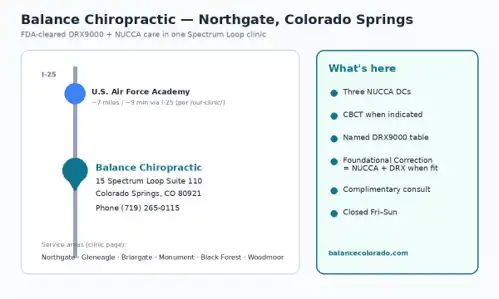
Balance Chiropractic
15 Spectrum Loop Suite 110
Colorado Springs, CO 80921
Phone: (719) 265-0115
Web: https://www.balancecolorado.com
Hours: Monday 8:00am–12:00pm & 2:00pm–6:00pm · Tuesday 2:00pm–6:00pm · Wednesday & Thursday 8:00am–12:00pm & 2:00pm–6:00pm · Friday–Sunday closed.
Northgate / Spectrum Loop serves patients from Gleneagle, Briargate, Monument, Black Forest, Woodmoor, and the broader Colorado Springs area near I-25 and the U.S. Air Force Academy corridor. Call to ask whether a complimentary consult makes sense for your history and imaging — and bring the questions above so any clinic’s table claims stay concrete.

OFFICE HOURS
Monday
8:00am - 12:00pm
2:00pm - 6:00pm
Tuesday
2:00pm - 6:00pm
Wednesday
8:00am - 12:00pm
2:00pm - 6:00pm
Thursday
8:00am - 12:00pm
2:00pm - 6:00pm
Friday
Closed
Saturday & Sunday
Closed

Balance Chiropractic
15 Spectrum Loop Suite 110
Colorado Springs, CO 80921